Does Feed Dicalcium Phosphate Contain Water
 | |
 | |
| Names | |
|---|---|
| IUPAC name calcium hydrogen phosphate | |
| Other names calcium hydrogen phosphate, | |
| Identifiers | |
| CAS Number |
|
| 3D model (JSmol) |
|
| ChemSpider |
|
| ECHA InfoCard | 100.028.933 |
| E number | E341(ii) (antioxidants, ...) |
| PubChem CID |
|
| UNII |
|
| CompTox Dashboard (EPA) |
|
| InChI
| |
| SMILES
| |
| Properties | |
| Chemical formula | CaHPO4 |
| Molar mass | 136.06 g/mol (anhydrous) 172.09 (dihydrate) |
| Appearance | white powder |
| Odor | odorless |
| Density | 2.929 g/cm3 (anhydrous) 2.31 g/cm3 (dihydrate) |
| Melting point | decomposes |
| Solubility in water | 0.02 g/100 mL (anhydrous) 0.02 g/100 mL (dihydrate) |
| Structure | |
| Crystal structure | triclinic |
| Hazards | |
| NFPA 704 (fire diamond) | 1 0 0 |
| Flash point | Non-flammable |
| Related compounds | |
| Other anions | Calcium pyrophosphate |
| Other cations | Magnesium phosphate Monocalcium phosphate Tricalcium phosphate Strontium phosphate |
| Except where otherwise noted, data are given for materials in their standard state (at 25 °C [77 °F], 100 kPa). Infobox references | |


Dicalcium phosphate is the calcium phosphate with the formula CaHPO4 and its dihydrate. The "di" prefix in the common name arises because the formation of the HPO4 2– anion involves the removal of two protons from phosphoric acid, H3PO4. It is also known as dibasic calcium phosphate or calcium monohydrogen phosphate. Dicalcium phosphate is used as a food additive, it is found in some toothpastes as a polishing agent and is a biomaterial.[1] [2]
Preparation [edit]
Dibasic calcium phosphate is produced by the neutralization of calcium hydroxide with phosphoric acid, which precipitates the dihydrate as a solid. At 60 °C the anhydrous form is precipitated:[3]
H3PO4 + Ca(OH)2 → CaHPO4 +2H2O
To prevent degradation that would form hydroxyapatite, sodium pyrophosphate or trimagnesium phosphate octahydrate are added when for example, dibasic calcium phosphate dihydrate is to be used as a polishing agent in toothpaste.[1]
In a continuous process CaCl2 can be treated with (NH4)2HPO4 to form the dihydrate:
CaCl2 + (NH4)2HPO4 → CaHPO4•2H2O + 2NH4Cl
A slurry of the dihydrate is then heated to around 65–70 °C to form anhydrous CaHPO4 as a crystalline precipitate, typically as flat diamondoid crystals, which are suitable for further processing.[4]
Dibasic calcium phosphate dihydrate is formed in "brushite" calcium phosphate cements (CPC's), which have medical applications. An example of the overall setting reaction in the formation of "β-TCP/MCPM" (β-tricalcium phosphate/monocalcium phosphate) calcium phosphate cements is:[5]
Ca3(PO4)2 + Ca(H2PO4)2•H2O + 7 H2O → 4 CaHPO4•2H2O

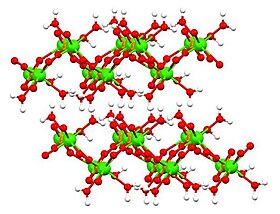
Portion of the lattice of dicalcium phosphate dihydrate, highlighting the 8-coordinated Ca2+ center and the location the protons on three ligands (green = calcium, red = oxygen, orange = phosphorus, white = hydrogen)
Structure [edit]
Three forms of dicalcium phosphate are known:
- dihydrate, CaHPO4•2H2O ('DPCD'), the mineral brushite
- monohydrate, CaHPO4•H2O ('DCPM')
- anhydrous CaHPO4, ('DCPA'), the mineral monetite. Below pH 4.8 the dihydrate and anhydrous forms of dicalcium phosphate are the most stable (insoluble) of the calcium phosphates.
The structure of the anhydrous and dihydrated forms have been determined by X-ray crystallography and the structure of the monohydrate was determined by electron crystallography. The dihydrate[6] (shown in table above) as well as the monohydrate[7] adopt layered structures.
Uses and occurrence [edit]
Dibasic calcium phosphate is mainly used as a dietary supplement in prepared breakfast cereals, dog treats, enriched flour, and noodle products. It is also used as a tableting agent in some pharmaceutical preparations, including some products meant to eliminate body odor. Dibasic calcium phosphate is also found in some dietary calcium supplements (e.g. Bonexcin). It is used in poultry feed. It is also used in some toothpastes as a tartar control agent.[8]
Heating dicalcium phosphate gives dicalcium diphosphate, a useful polishing agent:
2 CaHPO4 → Ca2P2O7 + H2O
In the dihydrate (brushite) form it is found in some kidney stones and in dental calculi.[9] [3]
See also [edit]
- Brushite
- Monocalcium phosphate
- Tricalcium phosphate
References [edit]
- ^ a b Corbridge, D. E. C. (1995). "Phosphates". Phosphorus - an Outline of its Chemistry, Biochemistry and Uses. Studies in Inorganic Chemistry. Vol. 20. pp. 169–305. doi:10.1016/B978-0-444-89307-9.50008-8. ISBN9780444893079.
- ^ Salinas, Antonio J.; Vallet-Regí, María (2013). "Bioactive ceramics: From bone grafts to tissue engineering". RSC Advances. 3 (28): 11116. Bibcode:2013RSCAd...311116S. doi:10.1039/C3RA00166K.
- ^ a b Rey, C.; Combes, C.; Drouet, C.; Grossin, D. (2011). "Bioactive Ceramics: Physical Chemistry". Comprehensive Biomaterials. pp. 187–221. doi:10.1016/B978-0-08-055294-1.00178-1. ISBN9780080552941.
- ^ Ropp, R.C. (2013). "Group 15 (N, P, As, Sb and Bi) Alkaline Earth Compounds". Encyclopedia of the Alkaline Earth Compounds. pp. 199–350. doi:10.1016/B978-0-444-59550-8.00004-1. ISBN9780444595508.
- ^ Tamimi, Faleh; Sheikh, Zeeshan; Barralet, Jake (2012). "Dicalcium phosphate cements: Brushite and monetite". Acta Biomaterialia. 8 (2): 474–487. doi:10.1016/j.actbio.2011.08.005. PMID 21856456.
- ^ Curry, N. A.; Jones, D. W. (1971). "Crystal structure of brushite, calcium hydrogen orthophosphate dihydrate: A neutron-diffraction investigation". Journal of the Chemical Society A: Inorganic, Physical, Theoretical: 3725. doi:10.1039/J19710003725.
- ^ Lu, Bing-Qiang; Willhammar, Tom; Sun, Ben-Ben; Hedin, Niklas; Gale, Julian D.; Gebauer, Denis (2020-03-24). "Introducing the crystalline phase of dicalcium phosphate monohydrate". Nature Communications. 11 (1): 1546. Bibcode:2020NatCo..11.1546L. doi:10.1038/s41467-020-15333-6. ISSN 2041-1723. PMC7093545. PMID 32210234.
- ^ Schrödter, Klaus; Bettermann, Gerhard; Staffel, Thomas; Wahl, Friedrich; Klein, Thomas; Hofmann, Thomas (2008). "Phosphoric Acid and Phosphates". Ullmann's Encyclopedia of Industrial Chemistry. doi:10.1002/14356007.a19_465.pub3. ISBN978-3527306732. S2CID 94458523.
- ^ Pak, Charles Y.C.; Poindexter, John R.; Adams-Huet, Beverley; Pearle, Margaret S. (2003). "Predictive value of kidney stone composition in the detection of metabolic abnormalities". The American Journal of Medicine. 115 (1): 26–32. doi:10.1016/S0002-9343(03)00201-8. PMID 12867231.
Source: https://en.wikipedia.org/wiki/Dicalcium_phosphate
0 Response to "Does Feed Dicalcium Phosphate Contain Water"
Post a Comment